
In life sciences, drug discovery, diagnostic technology development, and chemical engineering, researchers are facing a shared challenge: how to obtain high-quality data with smaller sample volumes, shorter experimental cycles, and better process control. Conventional experimental systems often require large reagent volumes, extended reaction times, and multiple manual steps. Microfluidic technology, by contrast, enables precise manipulation of fluids within microscale channel networks, allowing mixing, reaction, separation, detection, and cell culture to be integrated on compact chip-based platforms.
The value of microfluidics lies not only in miniaturization, but also in its ability to make experiments more controllable, reproducible, and scalable. Whether used for droplet generation, single-cell analysis, cell co-culture, organ-on-a-chip modeling, nucleic acid detection, immunoassays, microreactor development, or complex biological sample processing, microfluidic platforms provide researchers with powerful tools for building more physiologically relevant, reagent-saving, and high-throughput experimental systems.
Creative Biolabs has developed a comprehensive product portfolio designed to meet the diverse needs of scientific researchers. The product line covers not only ready-to-use microfluidic chips, but also the reagents, accessories, consumables, and supporting components required to build complete and reliable microfluidic workflows. From chip selection and fluidic connection to droplet generation, sample processing, and system assembly, Creative Biolabs helps research teams deploy microfluidic technologies more efficiently and confidently.
A One-Stop Microfluidic Product Portfolio: From Core Chips to Experimental Support Systems
The success of a microfluidic experiment does not depend on the chip alone. Chip material, channel geometry, surface properties, fluidic connections, droplet stabilization systems, bubble control, sealing performance, and fixture design can all influence experimental stability and reproducibility. Creative Biolabs’ product portfolio is built around these practical research needs, offering microfluidic chips made from different materials and designed for various applications, along with reagents, tubing, interfaces, fixtures, and bubble traps that support stable chip operation.
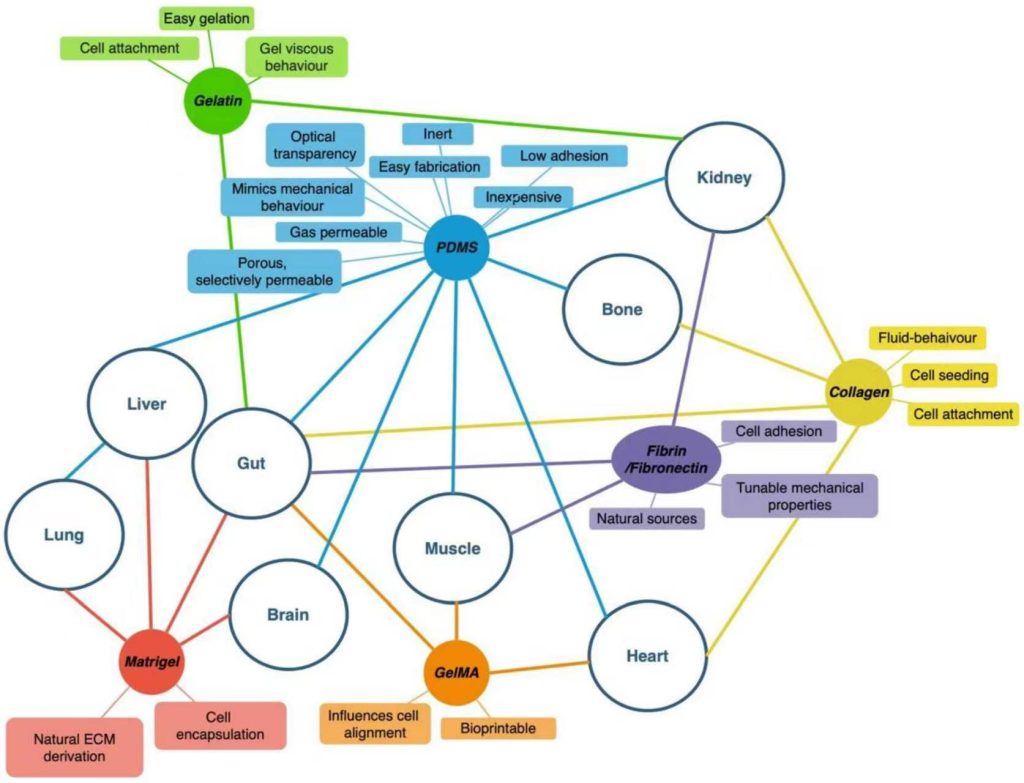
Fig. 1 Various organ-on-A-chip systems with their commonly used biomaterials (coloured circle) and associated properties (coloured square).1,2
Creative Biolabs’ microfluidic products are positioned to offer both standardization and flexibility. Standardized products help customers shorten project initiation time, while customization capabilities and technical expertise support more complex experimental scenarios.
Polymer Microfluidic Chips: Practical, Flexible, and Cost-Effective Tools for Prototyping and Biological Research
Polymer microfluidic chips are among the most widely used products in microfluidic research, especially for rapid prototyping, biological assay development, cell culture, drug screening, and early-stage method optimization. Creative Biolabs provides polymer-based microfluidic chips, including PDMS chips and thermoplastic chips, to support a broad range of experimental needs.
PDMS has long been one of the most popular materials in biological microfluidics due to its mature soft lithography process, ease of fabrication, high structural fidelity, low background fluorescence, and gas permeability. For projects requiring microscopic observation, fluorescence detection, cell culture, or short-cycle experimental validation, PDMS chips offer significant advantages. Its gas permeability is particularly useful in cell culture systems, where oxygen and carbon dioxide exchange can support more favorable microenvironmental conditions.
However, professional material selection must also consider limitations. PDMS is naturally hydrophobic and may adsorb small molecules, drug compounds, or biomolecules, which can affect experimental accuracy. It is also not ideal for some organic solvent systems. For applications requiring higher chemical resistance, improved batch-to-batch consistency, or lower molecular adsorption, thermoplastic materials such as PMMA, PC, PET, COC, and COP may be more suitable.
With Creative Biolabs’ professional support, researchers can reduce trial-and-error in material selection, channel design, and experimental optimization.
Glass Microfluidic Chips: High Stability, Superior Optical Performance, and Excellent Chemical Compatibility
When experiments require higher chemical stability, better optical properties, stronger mechanical performance, or greater thermal tolerance, glass microfluidic chips provide unique advantages. Glass chips are particularly suitable for applications involving organic solvents, acidic or alkaline reagents, surface modification, covalent biomolecule coupling, optical detection, and high-pressure fluidic operations.
Glass offers high optical transparency, low background fluorescence, mechanical strength, thermal stability, and high electrical resistance. These properties make it suitable for fluorescence detection, electrophoretic separation, chemical reactions, droplet generation, mixing, liposome preparation, and other demanding microfluidic applications.
Creative Biolabs offers a variety of glass microfluidic chip products, including flow-focusing droplet generation chips, double emulsion droplet chips, herringbone microfluidic chips, and enhanced oil recovery chips. Flow-focusing glass chips can be used to generate highly uniform droplets under appropriate experimental conditions, while herringbone microfluidic chips use asymmetric groove structures to induce chaotic advection and enhance mixing under low Reynolds number conditions.
Glass chips can be more challenging to fabricate than polymer chips due to the brittleness of the material and the need for specialized processing equipment. However, Creative Biolabs’ experience in glass microfluidic chip development helps bridge the gap between high-precision fabrication and practical application needs.
Silicon Microfluidic Chips: High Precision for Complex Structures and Advanced Microfabrication
For research projects requiring extremely high fabrication accuracy, complex microstructures, and high-resolution channel features, silicon microfluidic chips are an important option. Silicon offers a mature microfabrication foundation, strong mechanical properties, chemical stability, and good compatibility with advanced microscale engineering.
Silicon microfluidic chips are well-suited for applications such as microreactors, cell culture units, electrospray devices, digital microfluidics, and other systems that require high structural complexity and precise dimensional control. Silicon materials can also be modified through surface chemistry, enabling further functionalization and planar patterning.
Silicon chips are especially relevant to research institutions, advanced platform laboratories, diagnostic technology developers, and customers with clear micro- and nanofabrication requirements. For projects where channel dimensions, structural consistency, and resolution are critical, silicon chips provide a robust platform for high-performance microfluidic system development.
Electrode-Integrated Microfluidic Chips: Combining Fluidic Control with Electrical Functionality
As microfluidic research evolves from passive fluid handling toward integrated multiphysics systems, electrode-integrated microfluidic chips are becoming increasingly important. These chips combine microfluidic structures with metal electrode patterns, allowing researchers to introduce electric-field-based functions into chip-based experiments.
The integration of electrodes enables microfluidic chips to do more than transport and mix fluids. They can actively manipulate charged particles, cells, nucleic acids, and chemical reactions. For example, in electrophoretic separation, electric fields generated by metal electrodes can separate charged particles based on their charge and size. In electroporation studies, electric fields can temporarily alter cell membrane permeability, facilitating the exchange of materials across the cell membrane.
For customers, the challenge in electrode-integrated chip development often lies not only in the electrode itself, but also in the compatibility among electrode material, electrode pattern, chip substrate, channel geometry, packaging, sealing, and system-level operation. Creative Biolabs supports customers by combining microfluidic design expertise with electrode chip fabrication capabilities, helping transform experimental concepts into functional devices.
Microfluidic-Related Reagents: Key Components for Stable Droplet Generation
Droplet microfluidics is one of the most powerful and rapidly expanding areas of microfluidic technology. It is widely used in single-cell analysis, digital PCR, molecular screening, enzyme reactions, drug delivery research, and high-throughput assay development. However, the stability of droplet experiments depends heavily on the oil phase, surfactants, surface treatment reagents, and emulsion-breaking systems.
Creative Biolabs provides microfluidic-related reagents designed to support droplet generation and improve experimental reproducibility. These products include fluorinated surfactants, fluorinated oils, surface coating agents, and emulsion breakers. Together, they help researchers generate stable droplets, maintain droplet integrity during downstream processes, reduce unwanted coalescence, and recover droplet contents when needed.
Microfluidic Accessories: The Hidden Infrastructure Behind Reliable System Operation
Microfluidic experiments are often described as “chip-based experiments,” but in practice, system performance depends heavily on accessories and supporting components. Tubing compatibility, interface sealing, fixture stability, and bubble control can directly determine whether an experiment runs smoothly.
Creative Biolabs provides microfluidic accessories such as tubing, interfaces, fixtures, bubble traps, droplet generation kits, PDMS microporous membranes, and silicon wafers. These products are essential for connecting chips to external pumps, reservoirs, detection systems, and experimental platforms.
- Tubing enables liquid transfer between pumps and microfluidic chips.
- Interfaces connect microscale chip ports with macroscale experimental systems.
- Fixtures help secure chips and maintain stable sealing, especially in non-PDMS devices.
- Bubble traps are used to remove microbubbles from aqueous samples, helping prevent flow disruption, signal interference, and experimental failure.
- PDMS microporous membranes are useful components in organ-on-a-chip systems due to their transparency, biocompatibility, and flexibility.
- Silicon wafers can serve as raw materials for silicon-based chip fabrication.
- Droplet generation kits provide convenient reagent combinations for droplet-based experiments, helping reduce the burden of selecting individual components.
Why Choose Creative Biolabs Microfluidic Products?
- First, Creative Biolabs provides microfluidic chips made from different materials and designed for different functional requirements.
- Second, Creative Biolabs focuses on complete experimental workflows rather than chips alone. By providing droplet generation reagents, fluorinated oils, surfactants, surface treatment agents, emulsion breakers, tubing, interfaces, fixtures, and bubble traps, Creative Biolabs helps customers build stable and reliable microfluidic systems more efficiently.
- Third, the product portfolio is strongly application-driven. It supports single-cell analysis, droplet microfluidics, organ-on-a-chip models, point-of-care testing development, nucleic acid detection, immunoassays, drug screening, microreactors, liposome preparation, enhanced oil recovery simulation, and electrochemical detection.
- Finally, Creative Biolabs offers professional technical support to help customers make informed decisions in product selection, experimental design, connection configuration, and system optimization.
Microfluidic technology is reshaping experimental workflows in life sciences, bioengineering, diagnostics, and chemical research. It enables researchers to model complex biological processes at smaller scales, obtain high-throughput data with reduced sample consumption, and integrate sample handling, reaction, separation, detection, and culture processes into compact and controllable platforms.
Creative Biolabs provides a complete product ecosystem covering polymer chips, glass chips, silicon chips, electrode-integrated chips, droplet generation reagents, accessories, and consumables. Whether customers are conducting early-stage method validation, building stable droplet generation platforms, developing organ-on-a-chip models, designing electrochemical detection systems, or constructing high-precision microreactors, Creative Biolabs offers professional, flexible, and scalable product support.
References
- Cao, Uyen MN, et al. “Microfluidic organ-on-a-chip: a guide to biomaterial choice and fabrication.” International Journal of Molecular Sciences 4 (2023): 3232. https://doi.org/10.3390/ijms24043232
- Distributed under Open Access license CC BY 4.0, without modification.