
Uniform droplets are a promising start to a microfluidic experiment. Reliable data require more: consistent sample loading, stable compartment composition, suitable detection, and a workflow that performs throughout the intended assay duration. A device can produce visually convincing droplets while leaving one or more of these requirements unresolved.
For teams developing cell assays, enzyme screens, or miniaturized reactions, reproducibility is therefore a property of the complete workflow. The chip, fluids, control system, biological sample, and analysis method need to work together under realistic operating conditions.
Creative Biolabs’ Droplet Generator and Flow Chemistry Microfluidic Solutions provide a starting point for discussing custom device development and workflow requirements.
Select Materials for the Actual Fluids and Detection Method
The substrate should be selected alongside the oil, aqueous formulation, solvents, surface treatment, and operating temperature. A material that works well with a simple dye solution may behave differently with a protein-rich medium or a compound formulation containing an organic cosolvent.
PDMS is widely used for prototyping, but compatibility still needs to be established for the intended chemistry. Evaluate dimensional stability, surface behavior, and possible loss of the analyte to device materials where those effects could influence interpretation. Glass offers an alternative material strategy; its performance also depends on coatings, bonding, and the complete fluid-contacting path.
Creative Biolabs lists both a PDMS Flow Focusing Droplet Generation Chip and a Flow Focusing Droplet Generation Chip in Glass.
Establish a Stable Operating Window for Droplet Generation
Droplet formation reflects the interaction of geometry, wetting, flow, and interfacial properties. Adjusting an oil-to-aqueous flow ratio can change size, but the same numerical ratio does not guarantee equivalent performance in another chip or fluid system.
Ibrahim and colleagues combined experiments with a three-dimensional model to study a flow-focusing junction. Their original Figure 5 compares droplet diameter and spacing across flow-rate ratios and dispersed-phase flow rates. The results illustrate the value of characterizing a range of operating conditions instead of selecting a single visually successful setting.
Record absolute flow rates as well as their ratio. State whether the continuous-phase value refers to each side inlet or the combined flow. Creative Biolabs’ Microfluidic Laminar Flow Control Solutions can support discussions of channel design, flow-path optimization, and system integration.
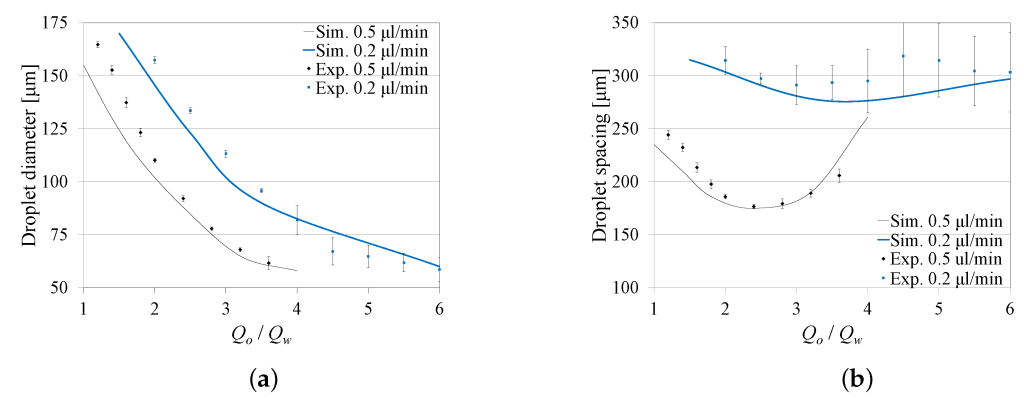
Figure 1. Droplet diameter and spacing as functions of flow-rate ratio in the studied junction. The authors define oil flow per lateral inlet; retain that convention when interpreting the axes.1,3
Verify the Formulation Through the Full Handling Sequence
- A surfactant formulation should support the complete assay, including collection, storage, incubation, and any subsequent manipulation. Preventing immediate coalescence is only one requirement. Compatibility with the biological reaction and optical readout also matters.
- Test the final aqueous composition early. Proteins, salts, solvents, and suspended particles can introduce behavior absent from a buffer-only demonstration. Keep formulation records specific enough to reproduce the experiment, including surfactant identity and concentration, oil identity, preparation procedure, and storage history.
- Examine droplets after the handling steps that the real experiment will use. A population that survives generation may change after transfer to a vessel, temperature exposure, or reinjection. Measure size distribution and integrity at those checkpoints, and retain representative images rather than recording only a pass or fail judgment.
The Droplet Generation All-in-one System described by Creative Biolabs integrates fluid delivery and imaging components. An integrated setup can simplify coordination and observation, while the assay-specific formulation and performance still require qualification.
Check Molecular Retention as Well as Physical Stability
Droplets that remain physically separate can still exchange dissolved compounds. Gruner and colleagues demonstrated molecular transport in water-in-fluorinated-oil emulsions, including contrasting fluorescence equilibration behavior for two dyes. Their work shows why an intact boundary is insufficient evidence that compartment contents remain isolated.
Use a retention experiment that reflects the intended assay duration and formulation. For example, compare initially loaded and unloaded droplets and follow both populations over time. Select reporters representative of the chemistry being measured; retention of one dye cannot establish retention of every substrate, product, or drug candidate.
Consider a changing signal alongside photobleaching and chemical conversion controls before attributing it to transport. Distinguishing these explanations is particularly useful when a screening workflow depends on preserving an association between a compartment and its reaction product.
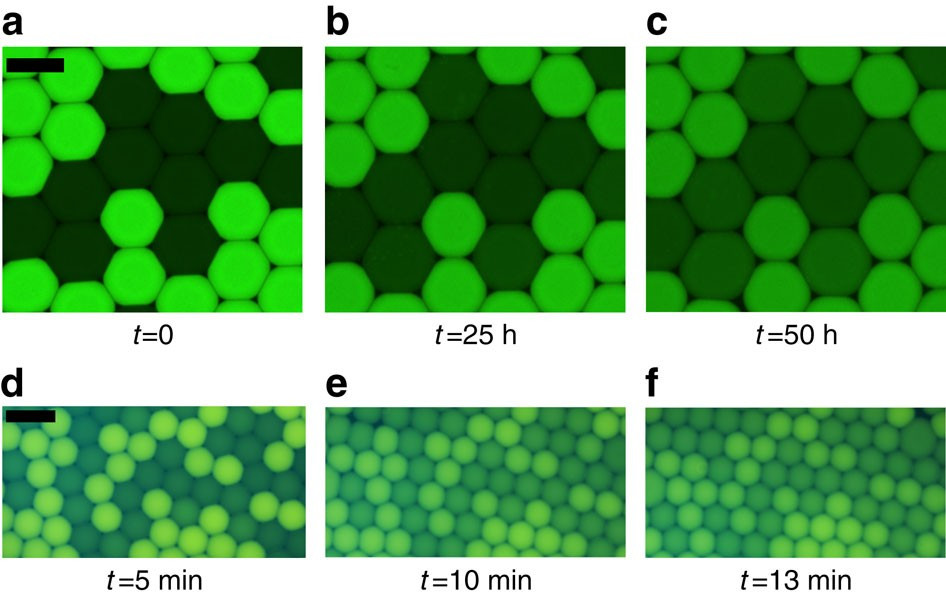
Figure 2. Fluorophore exchange between droplets under the reported conditions. Fluorescein exchanges over days and rhodamine 6G over minutes; their aqueous formulations also differ. These are system-specific observations.2,3
Measure Cell Occupancy Instead of Assuming Single Cell Loading
When droplets contain cells, a uniform size distribution does not establish uniform occupancy. Random independent loading produces empty droplets, single-cell droplets, and droplets containing multiple cells. Increasing the cell concentration can improve the fraction of occupied compartments while also increasing multiplets.
As a mathematical illustration, an ideal Poisson loading model with an average of 0.1 cells per droplet predicts approximately 90.5% empty droplets, 9.0% single-cell droplets, and 0.5% multiplets. These are model predictions, not specifications for a device. Aggregation, settling, and changes in the suspension during operation can cause experimental loading to differ.
Measure occupancy at multiple points during the run, together with viability where relevant. Record whether cells remain dispersed, whether their concentration changes in the reservoir, and whether processing alters their subsequent response. The endpoint may require a recovery assay or a functional comparison, because immediate membrane integrity alone does not answer every biological question.
Creative Biolabs’ Custom Microfluidic Cell Encapsulation Solutions and broader Custom Microfluidic Encapsulation Services offer relevant routes for discussing payload, occupancy, and downstream handling requirements.
Use a Qualification Matrix to Find the Remaining Uncertainty
A compact matrix helps connect a visible symptom to the next useful measurement. It should guide investigation rather than assign a cause without evidence.
| Observation | Variables to investigate | Useful verification |
| Size changes during a run | Flow drift, obstruction, wetting, reservoir conditions | Time-resolved size and operating records |
| Droplets merge after collection | Formulation, collection method, temperature, handling | Integrity before and after each handling step |
| Signal appears in unloaded droplets | Molecular transport, contamination, detection background | Paired loaded and unloaded controls over time |
| Cell occupancy changes | Settling, aggregation, concentration drift | Occupancy measurements at run intervals |
| Results differ between chips | Geometry, surface treatment, assembly, operating setup | Repeat qualification with documented chip lots |
Prepare the Workflow for Transfer and Routine Use
Once feasibility is established, document the information another operator needs: device version, fluid preparation, connection scheme, startup procedure, operating settings, collection method, analysis rules, and acceptance criteria. Record changes to the process rather than treating a revised chip or surface treatment as automatically equivalent.
If throughput must increase, evaluate the useful assay output rather than generation rate alone. Collection capacity, incubation, detection, and data processing can become limiting steps. Parallelization or faster flow should therefore be assessed for its effect on the entire workflow, including pressure balance, droplet integrity, and sample recovery.
Creative Biolabs’ Customized Microfluidic Manufacturing Services provide a route for discussing device fabrication and transfer requirements. A focused project brief should identify the assay, fluids, target size range, duration, sample limits, detection method, and current failure point.
Explore Creative Biolabs’ One-Stop Microfluidic Solutions to discuss a workflow matched to your research needs. Share the result you need to measure and the stage at which variability appears so that the development plan can address a specific experimental decision.
References
- Ibrahim, Ali M., et al. “Modeling of Droplet Generation in a Microfluidic Flow-Focusing Junction for Droplet Size Control.” Micromachines, vol. 12, no. 6, 2021, article 590. https://doi.org/10.3390/mi12060590
- Gruner, Philipp, et al. “Controlling Molecular Transport in Minimal Emulsions.” Nature Communications, vol. 7, 2016, article 10392. https://doi.org/10.1038/ncomms10392
- Distributed under Open Access license CC BY 4.0, without modification.